Research
How to compare research papers and build a literature review
Move from individual paper summaries to an evidence-based argument. Define a question, compare study designs, build a synthesis matrix, and write a review with a worked fictional example.
- Literature reviews
- Evidence
- Synthesis
A folder of relevant papers is a collection. A literature review explains what that collection helps us understand: which conclusions recur, why findings differ, and what remains unresolved. The difficult part is deciding how the papers relate to one another.
This guide develops that reasoning with a fictional example about university study spaces. The example studies and numbers below were invented for teaching. They are not published evidence and must not appear in your reference list. Replace them with verified sources when applying the method.
1. Define what the review should explain
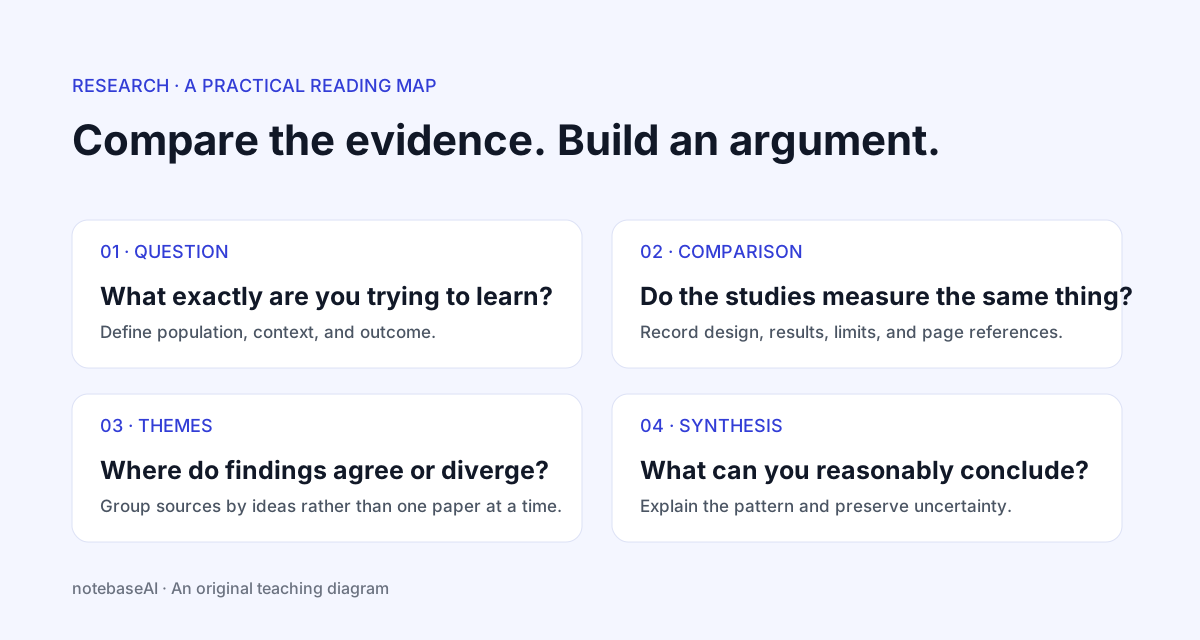
Begin with a question that makes papers comparable. “Student learning” is too broad to tell you what to include. A more useful question is: “How do quiet and collaborative campus study spaces affect undergraduate students’ concentration during independent coursework?” This identifies a population, a setting, and a specific outcome.
Write down the boundaries before searching: university students rather than all learners; campus spaces rather than home offices; concentration rather than examination scores alone. Boundaries are decisions you can explain, not a device for excluding inconvenient findings. If an unexpected paper makes you revise them, record the change.
Check your assignment or target journal for the required review type. A narrative literature review, scoping review, and systematic review have different methodological expectations. A handful of papers summarized with AI is not automatically a systematic review.
2. Find and screen sources deliberately
Break your question into concept groups, then list alternative expressions. A search might combine “university students” or “undergraduates” with “study spaces” or “library environment,” and “concentration” or “attention.” Adapt the syntax to your library database; search operators and phrase handling differ between services.
Keep a simple search log: database, date, query, filters, and reasons for excluding apparently relevant sources. Follow references backward to earlier work and look for later papers that cite a useful study. Finding several papers that repeat one another’s citations is not the same as discovering independent evidence.
Screen titles and abstracts first, then read the full text of promising papers. Verify the author, title, publication venue, year, and DOI or stable link. Check whether a paper has a correction or retraction. A DOI identifies a work; it does not establish that its methods are sound or its conclusions apply to your question.
3. Build a comparison matrix
Use one row per study and a small set of columns that answer your review question. Record what was measured, how it was measured, and where the evidence appears. Write “not reported” when a paper does not provide a detail. Filling the gap with a plausible guess makes later synthesis unreliable.
| Teaching example | Design and participants | Reported observation | Important limit |
|---|---|---|---|
| Example A | Survey of 240 undergraduates at one campus | Students who preferred quiet rooms reported fewer interruptions | Self-reported preferences; students selected their own rooms |
| Example B | Crossover task with 48 volunteers in two rooms | More tasks completed in the quiet condition during a short session | Short task; room conditions and session order need checking |
| Example C | Interviews with 20 students using group rooms | Students valued discussion for difficult collaborative assignments | Interview accounts; no common concentration score |
Add separate columns for the paper’s claim, your interpretation, and a page, table, or section reference. That separation helps you notice when an author’s discussion goes beyond the measured result—and when your own explanation does.
4. Compare like with like
Examples A and B offer different kinds of evidence: reported experience and observed short-task performance. Example C addresses the usefulness of conversation for collaborative work. It does not contradict a finding about quiet conditions during independent work. Before calling findings inconsistent, compare the task, setting, participants, intervention, and outcome.
Distinguish association from causation. Students who choose quiet rooms may differ from students who choose group rooms in motivation, task type, schedule, or prior habits. A stronger causal design addresses those alternative explanations; an appealing result alone does not.
Do not count three favorable papers as three equal votes. Examine sample selection, measurement quality, missing data, appropriate comparison groups, and whether the reported uncertainty supports a confident statement. A small well-controlled study and a large convenience survey answer different questions. Neither sample size nor a statistically significant result settles the whole evaluation.
Also distinguish “the study found no clear difference” from “the conditions are equivalent.” An imprecise estimate may be compatible with several meaningful differences. Preserve the reported uncertainty rather than upgrading an inconclusive result into proof of no effect.
5. Write a synthesis, with an example
Purdue OWL’s literature-review guidance emphasizes connecting and evaluating sources. In practice, give each paragraph a question or claim that several sources help answer. Explain the relationship between the sources and attach qualifications where they matter.
The second version connects an idea to multiple sources, explains their differences, and states what the combined evidence cannot establish. In a real review, replace the example labels with the citations your discipline requires, and verify every claim against the actual papers.
6. Turn themes into a review structure
Arrange sections around the problem your review is solving. For the fictional question, useful sections could cover independent concentration, collaborative problem-solving, differences in outcome measurement, and gaps in longer-term evidence. That arrangement gives each paper a role in an argument.
Use chronology when development over time is central, and methods when different designs explain the disagreement. Avoid chronological order merely because your reference manager sorts by year. The UNC Writing Center’s review guidance is useful for choosing an organizing principle and checking it against the assignment.
Conclude by answering the review question at the strength the evidence permits. Identify a specific gap, such as a lack of comparable long-term outcomes in the selected studies. “More research is needed” says little unless you explain what needs measuring, with whom, and why it would change the interpretation.
7. Check the argument and its references
- Can a reader see the question, scope, and source-selection approach?
- Does each major claim point to evidence you actually read, with useful page or section notes?
- Have you explained differing findings before calling them contradictory?
- Are measured outcomes, participants, and study limits preserved in the synthesis?
- Do you include relevant evidence that challenges your preferred explanation?
- Does the conclusion avoid claiming a complete field-wide picture from a limited source set?
AI can help organize a matrix or suggest comparison questions. It cannot make a missing study exist, verify an unread reference for you, or turn incomplete retrieval into comprehensive coverage. Read the selected source passages and keep a record of where your synthesis comes from.
8. Practice and further reading
Choose three real papers about one narrow question. Fill the matrix without drafting a review paragraph first. Then write one paragraph that compares at least two papers and includes one meaningful qualification. Finally, remove any sentence that is supported only by your memory of an abstract.
For an app-based starting point, follow the first-notebook walkthrough, then use the research-notes guide to keep evidence and interpretation separate.