Reading & Understanding
How to break down a difficult research paper into clear explanations
Read with a purpose, unpack unfamiliar terms, follow the evidence, and explain a paper without overstating its results. Includes a worked example, figure-reading checks, and reusable questions.
- Research papers
- Critical reading
A difficult paper often combines several problems: unfamiliar vocabulary, a method you have not encountered, dense figures, and assumptions the authors do not explain. Reading every line repeatedly rarely tells you which problem is blocking you.
A better approach is to build a map of the argument, identify the specific missing knowledge, and connect each explanation to evidence in the paper. Your goal is to explain what the authors asked, what they did, what they found, and how far the finding can reasonably travel.
1. Choose the question you need answered
Decide why you are reading. You might need background for an essay, a method to reproduce, a result to compare, or an explanation for a seminar. Each purpose requires a different depth of reading. You can assess relevance without understanding every equation; reproducing an analysis requires considerably more detail.
Keep a question list beside your notes. Separate questions the paper can answer from questions requiring background reading. “How were participants selected?” belongs in the paper. “What is a crossover design?” may require a methods textbook. This distinction prevents an AI explanation of general background from being mistaken for something the authors actually wrote.
2. Map the paper before reading closely
S. Keshav’s How to Read a Paper describes reading in passes: establish the overall purpose, inspect the substance, and investigate details when the goal warrants it. You can adapt that idea to your field rather than forcing every paper into the same reading schedule.
First inspect the title, abstract, headings, conclusion, and figure captions. Write a provisional sentence about the paper’s main question. Then trace the route from question to method to result. Finally, return to difficult passages whose details affect your interpretation. It is reasonable to stop when a paper does not answer your question.
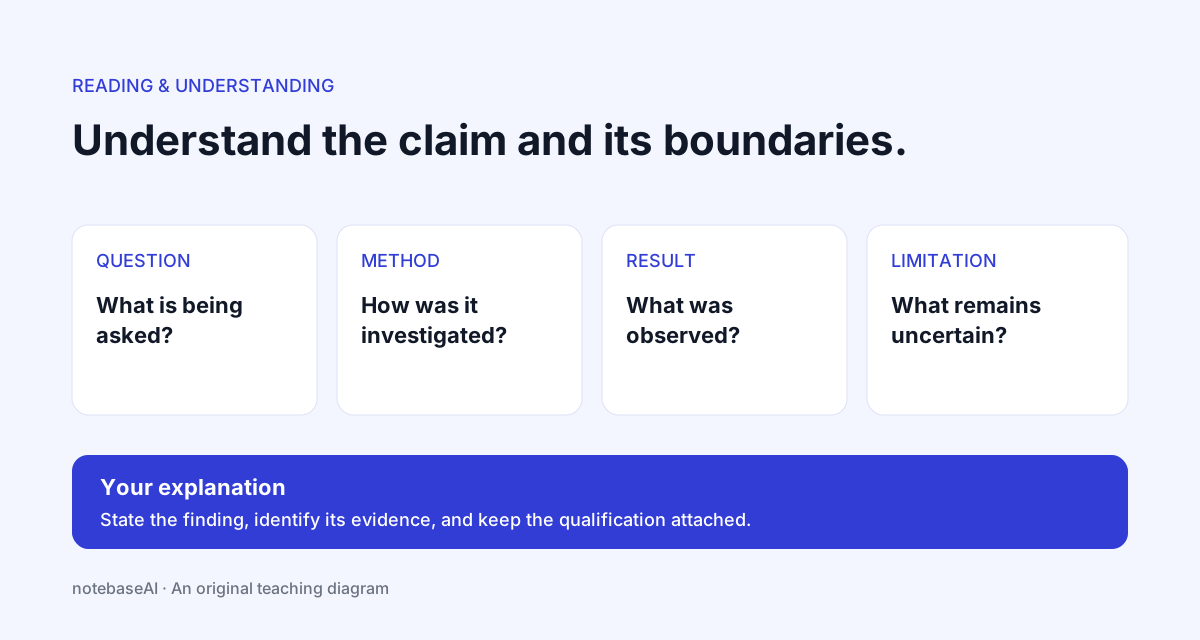
For an empirical study, begin a four-line note: question, design, observation, limitation. For a theoretical paper, replace “observation” with the proposition or argument and its assumptions. For a review, identify how sources were selected and how the authors synthesized them.
3. Unpack difficult terms and methods
Do not build an enormous glossary before understanding the problem. Pick the few terms that determine what the result means. For each, record a plain-language definition, the meaning in this paper, and a small example. If the authors use an operational definition, preserve it even if everyday usage differs.
| Term | Plain-language meaning | Question to ask of this paper |
|---|---|---|
| Outcome measure | The observation used to represent what the study is investigating | Is concentration measured by a task, a self-report, or something else? |
| Confounder | A factor that can help explain both the comparison and the outcome | Could task difficulty differ between the groups? |
| Confidence interval | An uncertainty interval associated with an estimation procedure | How wide is it, and which practically important effects remain compatible with it? |
| Generalizability | How a finding might apply beyond the observed participants and conditions | Do the participants, setting, and task resemble the situation I care about? |
Draw the method as a short sequence: who entered the study, what happened to them, what was measured, and what was compared. Mark whether groups were assigned or self-selected, whether measurements occurred once or repeatedly, and when missing data entered the analysis. The sequence is often easier to reason about than a dense paragraph.
An analogy can help you begin, but check where it breaks. Calling a confidence interval a “range of certainty,” for example, may hide the procedure’s assumptions. Use a trusted statistical or disciplinary reference when interpreting a technical method; a fluent paraphrase is not enough.
4. Read results, tables, and figures
Identify the population, comparison, units, and time period before interpreting the pattern. Read the caption and axes together. Check whether a value is a count, mean, percentage, relative change, or model-adjusted estimate. A rising line can represent a large or a small difference depending on the scale.
Locate the exact result behind a sentence in the discussion. Ask whether the paper reports uncertainty, whether the analysis was planned, and whether the outcome matters in practice. “Statistically significant” does not tell you that an effect is large, useful, or causal. “Not significant” does not prove two conditions are identical.
Write down one alternative explanation. If the paper addresses it, record how. If it does not, keep that uncertainty attached to your explanation. Do not turn your unanswered question into an accusation that the researchers necessarily made an error.
5. Build a careful explanation
Use this structure: the authors investigated a question in a defined setting, used a particular method, reported a specific observation, and offered an interpretation with limits. This produces a clear explanation without removing the context that makes it accurate.
The careful version is longer because it answers more questions. Once you have it, create a shorter version for your audience while keeping the essential qualification: “The classes differed in task completion, but this comparison alone does not establish the cause.”
6. Ask AI questions you can check
Use AI to expose the structure of a passage rather than merely replacing it with smoother prose. Ask for evidence and acknowledge missing information. General explanations can help with vocabulary, but distinguish them from source-specific facts.
| Your difficulty | A focused question |
|---|---|
| The method is confusing | Explain the study procedure as numbered steps. Cite the source for each step and label any details the paper does not report. |
| The conclusion seems too broad | Separate the measured finding from the authors’ interpretation. Identify the population, outcome, and study limitations with citations. |
| A term is unfamiliar | Explain this term in the context of the selected passage, then give a separate hypothetical example. Label background explanation separately from source claims. |
| Two sections seem inconsistent | Compare the claim in the discussion with the result in this table. Do they use the same outcome, participants, and time period? |
Open the cited passage after receiving an answer. Check the whole relevant paragraph or table rather than a sentence fragment. If an answer introduces an unexplained number, author, or procedure, ask where it appears and verify it yourself. The PDF-question guide demonstrates that app workflow with screenshots.
7. Test what you understand
Close the paper and explain its argument in a few sentences. Then reopen it and mark each sentence as accurate, incomplete, or unsupported. This separates familiarity with the words from an explanation you can actually produce.
Try a transfer question: “Would the conclusion necessarily apply to a different population or a longer time period?” Your answer should mention the relevant boundary, not just repeat the headline result. Write one question you still cannot answer and identify the next reading that could help.
Finish with a reusable reading note: bibliographic details, why you read the paper, the four-part evidence map, a short explanation in your own words, page references, and remaining questions. That note is more valuable later than an unstructured set of copied highlights.
8. Practice with a short source
Download the urban tree practice PDF. This one-page brief is fictional teaching material, not a published study. Use it to practice the controls and evidence checks without uploading private documents.
Identify what the urban tree pilot observed, which measurements are missing, and why one summer cannot establish a year-round result. Write a two-sentence explanation that includes that limit. If you catch yourself adding an average temperature the brief never reports, remove it.
Continue with organizing research notes, or compare several papers using the literature-review guide.